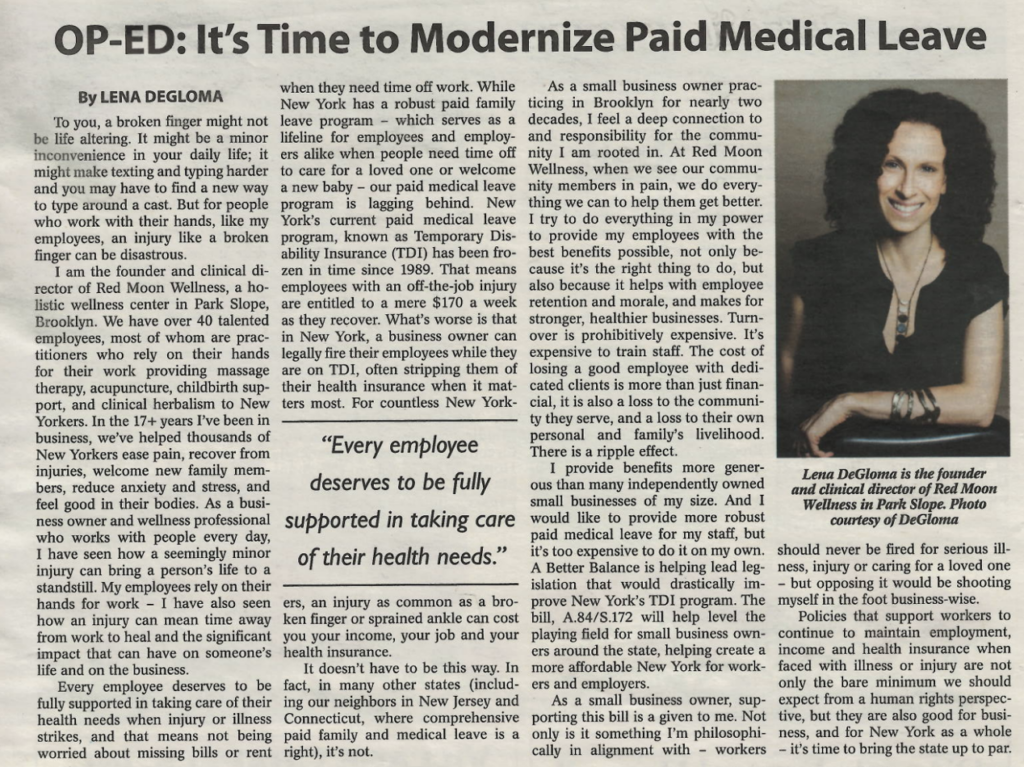
The following is an op-ed authored by Lena DeGloma, founder and clinical director of Red Moon Wellness in Park Slope, Brooklyn. This op-ed was originally published in print in the Brooklyn Downtown Star.
To you, a broken finger might not be life altering. It might be a minor inconvenience in your daily life; it might make texting and typing harder and you may have to find a new way to type around a cast. But for people who work with their hands, like my employees, an injury like a broken finger can be disastrous.
I am the founder and clinical director of Red Moon Wellness, a holistic wellness center in Park Slope, Brooklyn. We have over 40 talented employees, most of whom are practitioners who rely on their hands for their work providing massage therapy, acupuncture, childbirth support, and clinical herbalism to New Yorkers. In the 17+ years I’ve been in business, we’ve helped thousands of New Yorkers ease pain, recover from injuries, welcome new family members, reduce anxiety and stress, and feel good in their bodies. As a wellness professional who works with people every day, I have seen how a seemingly minor injury can bring a person’s life to a standstill. My employees rely on their hands for work–I have also seen how an injury can mean time away from work to heal and the significant impact that can have on someone’s life and on the business.
Every employee deserves to be fully supported in taking care of their health needs when injury or illness strikes, and that means not being worried about missing bills or rent when they need time off work. While New York has a robust paid family leave program – which serves as a lifeline for employees and employers alike when people need time off to care for a loved one or welcome a new baby – our paid medical leave program is lagging behind. New York’s current paid medical leave program, known as Temporary Disability Insurance (TDI) has been frozen in time since 1989. That means employees with an off-the-job injury are entitled to a mere $170 a week as they recover. What’s worse is that in New York, a business owner can legally fire their employees while they are on TDI, often stripping them of their health insurance when it matters most. For countless New Yorkers, an injury as common as a broken finger or sprained ankle can cost you your income, your job and your health insurance.
It doesn’t have to be this way. In fact, in many other states (including our neighbors in New Jersey and Connecticut, where comprehensive paid family and medical leave is a right), it’s not.
Having owned my business and practiced in Brooklyn for nearly two decades, I feel a deep connection to and responsibility for the community I am rooted in. At Red Moon Wellness, when we see our community members in pain, we do everything we can to help them get better. I try to do everything in my power to provide my employees with the best benefits possible, not only because it’s the right thing to do, but also because it helps with employee retention and morale, and makes for stronger, healthier businesses. Turnover is prohibitively expensive. It’s expensive to train staff. The cost of losing a good employee with dedicated clients is more than just financial, it is also a loss to the community they serve, and a loss to their own personal and family’s livelihood. There is a ripple effect.
I provide benefits more generous than many independently owned small businesses of my size. And I would like to provide more robust paid medical leave for my staff, but it’s too expensive to do it on my own. A Better Balance is leading the push for legislation that would drastically improve New York’s TDI program. The bill, A.84/S.172 will help level the playing field for small business owners around the state, helping create a more affordable New York for workers and employers.
As a small business owner, supporting this bill is a given to me. Not only is it something I’m philosophically in alignment with – workers should never be fired for serious illness, injury or caring for a loved one – but opposing it would be shooting myself in the foot business-wise.
Policies that support workers to continue to maintain employment, income and health insurance when faced with illness or injury are not only the bare minimum we should expect from a human rights perspective, but they are also good for business, and for New York as a whole – it’s time to bring the state up to par.