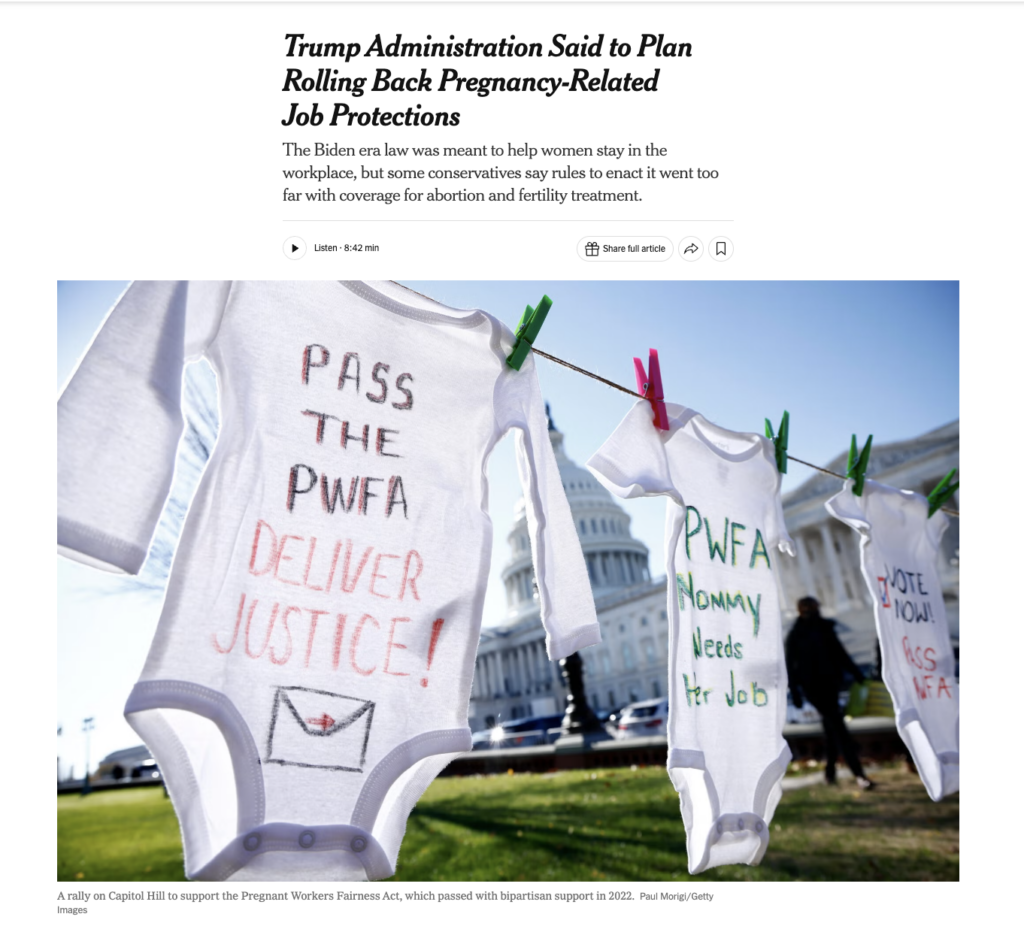
The New York Times just published a major new report highlighting the Trump Administration’s plan to gut critical protections for pregnant workers—part of the Administration’s broader efforts to force women out of the workforce and roll back the clock on gender equity.
A Better Balance has been long raising the alarm about the federal Equal Employment Opportunity Commission’s plan to significantly weaken the regulations that guide enforcement of the Pregnant Workers Fairness Act. This will only make it harder for women to seek out essential healthcare—without risking their jobs—as they navigate pregnancy, abortion, fertility treatment, and menstruation.
We will not let this happen on our watch. We will not go back to a time when women are denied control over their own reproductive and financial lives. We are fighting tooth and nail to keep the PWFA and its regulations strong, intact, and accessible to the working women who need these protections most urgently.
Below is an excerpt from the story in the New York Times:
The Trump administration is preparing to scale back workplace accommodations for women related to pregnancy and reproductive health, seven people with knowledge of discussions of the plans said.
The moves will limit the impact of a 2022 law that was meant to fill a gap in disability and discrimination protections that employees are guaranteed at workplaces. It was intended to provide accommodations for pregnant workers, such as bathroom and water breaks, reprieves from heavy lifting or time off for prenatal appointments.
But the scope of the regulations under the law, known as the Pregnant Workers Fairness Act, has been debated since their drafting. Conservatives, even some who supported the law, said the rule that the Equal Employment Opportunity Commission wrote to apply the law reached far beyond pregnancy to cover matters including abortion, fertility treatment and related procedures and conditions it was not meant to protect.
[…] The E.E.O.C. could cut the list of “related medical conditions,” putting the matter to employers and courts to decide, some of the people familiar with the matter said. They also said wider religious exemptions are under consideration that would allow employers to refuse accommodations to workers whose medical conditions are deemed incompatible with their beliefs, the people said.
“It’s social engineering disguised as bureaucratic rule making,” said Inimai Chettiar, president of A Better Balance, an organization that led the campaign for the law’s passage.