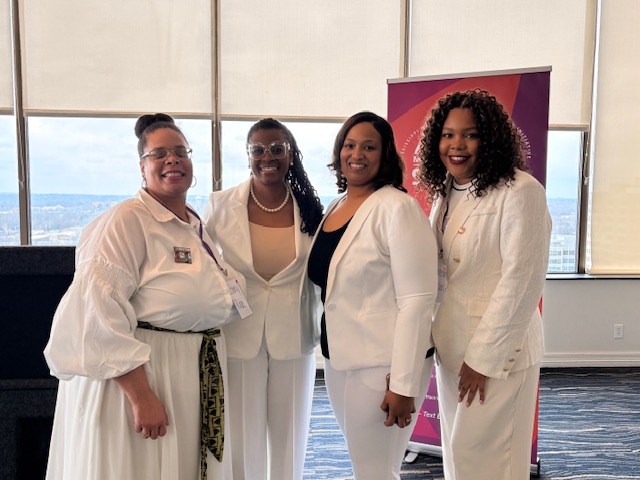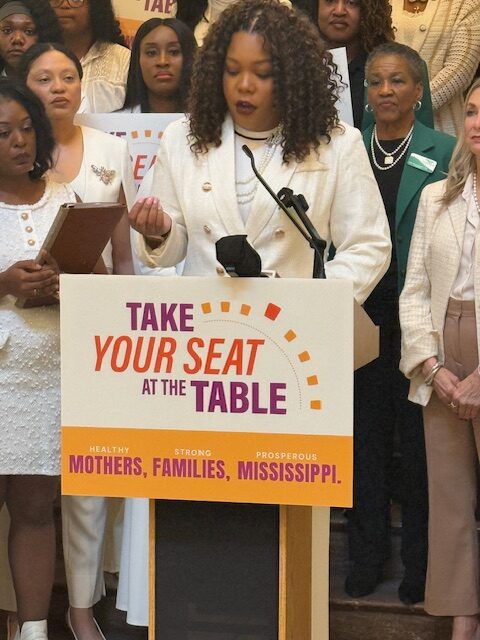
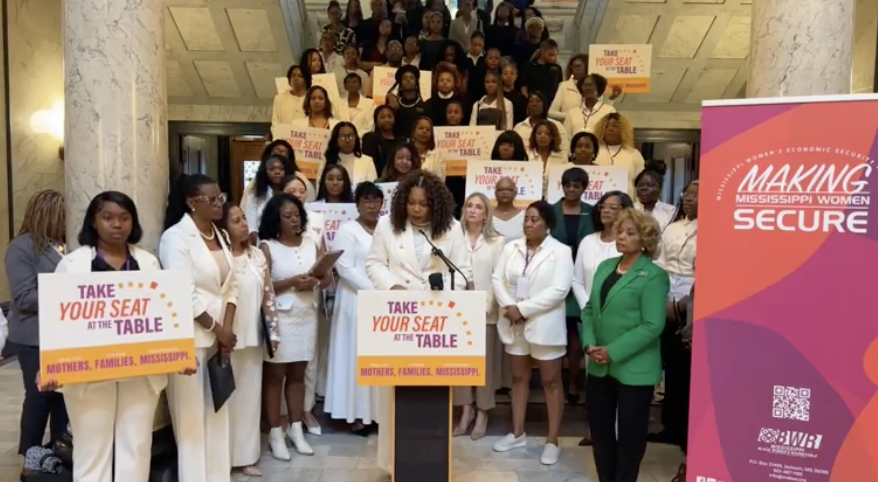
Last week, we joined the Mississippi Black Women’s Roundtable for their Advocacy Day at the Mississippi State Capitol, where we gathered alongside the Jackson Federation of Teachers, Six Dimensions, A Better Birth Mississippi, legislative champions, and other advocates in the state to highlight the policies state lawmakers can pass to help women and families thrive.
Kameron Dawson, the Legal Director of A Better Balance’s Southern Office, spoke at the event to highlight how paid family and medical leave can support the health and economic security of women in Mississippi. Last year, the Mississippi Legislature passed paid parental leave for state employees, changing the lives of more than 30,000 workers in the state by providing them with time off work to welcome a new child.
But still, about 76% of Mississippi workers, including educators and workers in low-wage hourly jobs, do not receive paid family leave through their employers – a disparity that disproportionately impacts Black women in the state. These gaps leave many Black women in the state faced with an impossible decision between their economic security, and their health and caregiving needs.
Workers in Mississippi with personal medical needs and caregiving responsibilities continue to face threats to their economic security without statewide policies like comprehensive paid family and medical leave – each year, Mississippians lose $372 million in wages due to unpaid or partially paid leave, $210 million of which is lost by women. Paid leave is linked to many benefits for business, like recruiting and retaining essential employees and reducing turnover. Mississippi has one of the nation’s lowest workforce participation rates at 53.9%, and for many Mississippians – particularly women and caregivers – a lack of access to supportive policies is a major barrier to joining and staying attached to the workforce.
Paid leave is also linked to many health benefits, including reduced infant mortality, postpartum depression, and fewer preterm births. As Mississippi continues to face a devastating maternal and infant health crisis, it’s clear that these systemic inequities need a structural fix. Workplace policies like paid leave can close these gaps, and support workers, families, and businesses in the state.
Having access to paid family and medical leave is absolutely critical to promote the health and economic security of Mississippi’s families, and as Kameron emphasized in her remarks, “Mississippi families need and deserve more.”