
For parents of babies in the neonatal intensive care unit (NICU), being present during this difficult and stressful time should be their number one priority – not worrying about how they’ll put food on the table if they miss work or lose their jobs.
During this challenging time, too many NICU parents are forced to weigh their economic security against being present with their babies, as highlighted by the Associated Press and USA Today. Many even delay their family leave to return to work within days of giving birth while their baby is still in the hospital, in order to avoid losing valuable bonding time when the baby is released from the NICU and returns home.
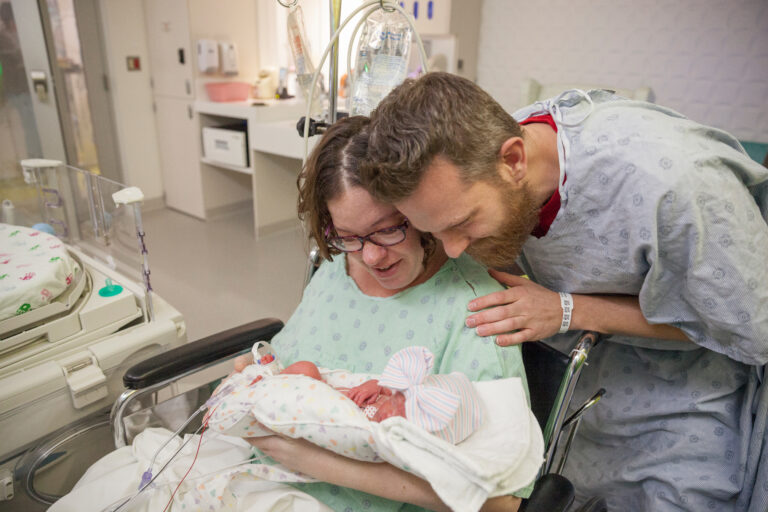
“I could only hold my son once a day for the first 3 months of his life. Nothing about this experience is parental bonding time; it’s pure survival. It’s emotionally exhausting. On top of going to the NICU to hear updates, I am constantly waiting for phone calls. I wouldn’t be able to keep working through all of this.”
– Angelina, NICU parent
Colorado recently modeled how lawmakers can better support NICU parents by expanding its paid leave program to include an additional 12 weeks of paid leave for these NICU families. Illinois also passed an unpaid NICU leave law in 2025 to ensure covered NICU parents don’t lose their jobs when their baby is in the hospital. More states are considering NICU leave measures – both paid and unpaid – to build on this momentum.
Now, Congress has the chance to extend a nationwide lifeline to NICU families by expanding the Family and Medical Leave Act (FMLA) to provide up to 12 extra weeks of unpaid, job-protected leave to parents with babies in the NICU – a common-sense solution supported by voters and lawmakers across party lines.
A Better Balance led the push to secure better protections for NICU parents in Colorado. In addition to building on this example in states across the country, we’re taking this policy solution to D.C. and urging Congress to follow suit.
“My daughter had complications and was being treated in the NICU, and I had to start interviewing and searching for a new job during the hardest time of my life.
The stress and anxiety I have endured without having access to adequate maternity leave and accommodations is something no mother should have to go through.”
Quick Facts:
- In the U.S., approximately 10% of babies are born preterm, and these babies often require specialized care in the NICU.
- Women in low-wage service jobs have a higher risk of preterm birth, and are also less likely to have access to paid leave. Similarly, young parents have a higher rate of preterm birth and are also less likely than other parents to have access to paid leave.
- Preterm birth rates are highest for Black mothers (15%), followed by American Indian/Alaska Native (13%), Pacific Islander (12%), and Latinx mothers (10%).
- Women with babies in the NICU are at increased risk for anxiety and depression compared to mothers whose babies are not in the NICU. Medical bills and related costs such as travel can further add to the stress and anxiety of having a child in the NICU.
- Parental engagement, frequency of NICU visitations, and more skin-to-skin care from NICU parents is associated with better developmental outcomes for NICU babies.
“Since my child spent the majority of my 6 week leave in the NICU, I was not able to fully bond with my child. When it was time for her to come home, it was not possible financially to stay at home without income due to additional hospital expenses.”
– Deanna, NICU parent
Are you a parent who struggled financially or had difficulty balancing work while your baby was in the NICU?
Resources
- Best Practices for State NICU Leave Policies
- Working Families Need NICU Leave: Expand the Family and Medical Leave Act (FMLA) to Protect NICU Parents and Babies
- Issue Spotlight: NICU Leave is a Common-Sense Policy that Supports Working Families and Improves the Health of NICU Parents and Babies
- NICU Parents Have Unique Lactation Needs – Expanded FMLA Leave Can Help: A Q&A with Naomi Bromberg Bar-Yam, PhD
- Young NICU Parents Face Economic Setbacks and Deserve More Supportive Laws
- What to Know About Expanding the FMLA for NICU Families (ABB x NICU Parent Network)
- Webinar: When Everyday Counts – Why Families Need Time to Care for their Babies in the NICU (with the National Collaborative for Infants & Toddlers and the Alliance for Early Success)
NICU Parents' Stories
- Associated Press Article: Tiny patients, big fight: NICU parents win leave in 2 states and push for more
- USA Today Article: Her baby had a medical emergency, she had a C-section. Work told her to log on anyway.
- Workers’ Voices Blog: I’m a NICU Mom and Postpartum Nurse – Every Day, Families Like Mine Face Impossible Choices
- Workers’ Voices Blog: My Son Has Been in the NICU for Months. Being There for Him Shouldn’t Mean Risking My Job
- Workers’ Voices Blog: I Started a New Job While Pregnant and Received No Maternity Leave